
BLACK AND WHITE COLLECTION I
The continuation of mankind is natural, but the social generation is shaped by a specific time and culture. Due to the different social and cultural environments, people from different generations have different values and behaviors. In these scenarios are gathered some youth and some elderly people, in their daily life behaviors.
The elder generation represents the continuity in tradition and cultures. Often in China can be seen kids that are grown up by their grandparents. These can happen because the generation of the parents is a busy generation that sees themselves in long working hours, competition in reaching a good career position.
Unlike in the West, where family members tend to treat each other as equals, members of a Chinese ideal family are differentiated by an unspoken hierarchical order. Under this hierarchical order, such principles as “respecting the old and caring for the young” (尊老爱幼, zhun lao ai you) and “loving fathers raise filial sons”(慈爱的父亲养育孝顺的儿子, ceai de fuqin yangyu xiaoshun de erzi) have become the code of ethics that binds a family together. The older generation is responsible for looking after the younger generation, while the younger generation should be obedient and respectful towards their elders. These principles, passed on by word of mouth and taught from one generation to another, have been ingrained in the Chinese psyche.
In this dialogue between kids and elder people the black and white is a choice to express the non-tempo situation, where the two situations of future and past intersect. The elder in urban China are actively occupying their time in a community that builds itself in public spaces, green spaces that can be found inside the vastest of developed Chinese urban areas. Is recurrent that people gather up in parks, largely present in all the cities. The varied use of the public parks comes from the fact that they are free, for everyone. Another reason of the large use of the use of public spaces is due to the high population, accommodations in fact do not include gardens, so the parks are treated as common people gardens.
What fascinates me about elder people in China, is their incessant vitality. You can meet them in all the public places of every Chinese city. You can meet them bended on their knees praying in temples, playing with their grandchildren, enjoying a group dancing in a park. It is also recurrent to meet in the morning a group of old people practicing Taijiquan or in the afternoon group of old people occupying their time by playing table games such as cards or Mahjong. These vitality has much more to communicate to the future generation. Will they go out in public spaces as their grandparents used to do, when they will reach the same age? Will they still know what being a community means? Will they be able to share the same values that naturally comes by being part of a community?


March 2018, Hainan, China
May 2018, Nanjing, China


July 2018, People’s Park, Chengdu, China


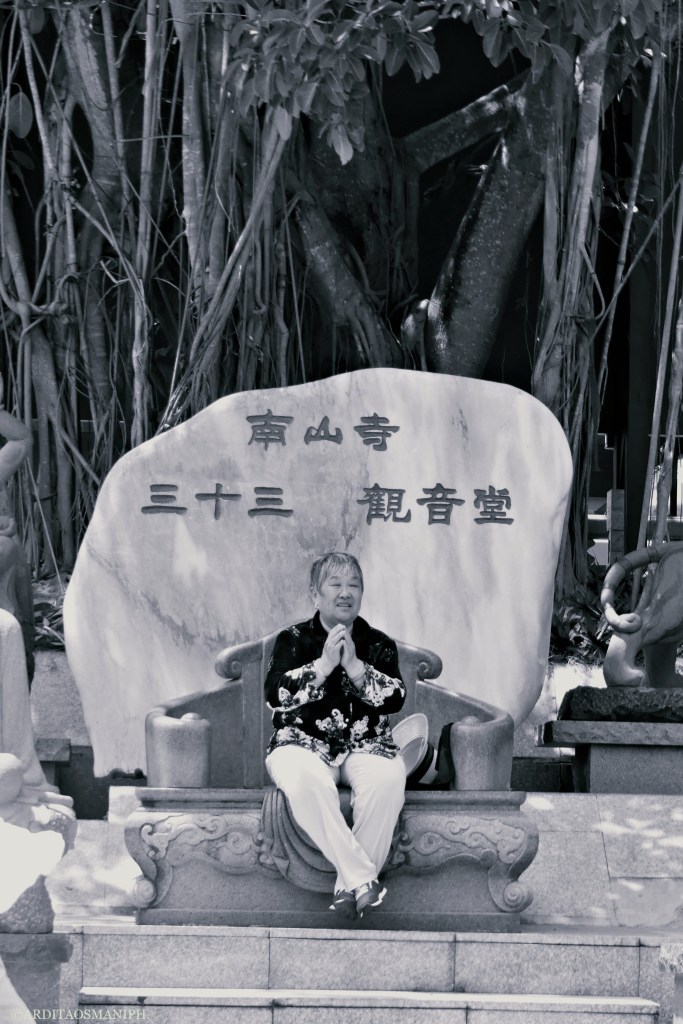

July 2018, Cengdu, China
 FuCinaOrientale